
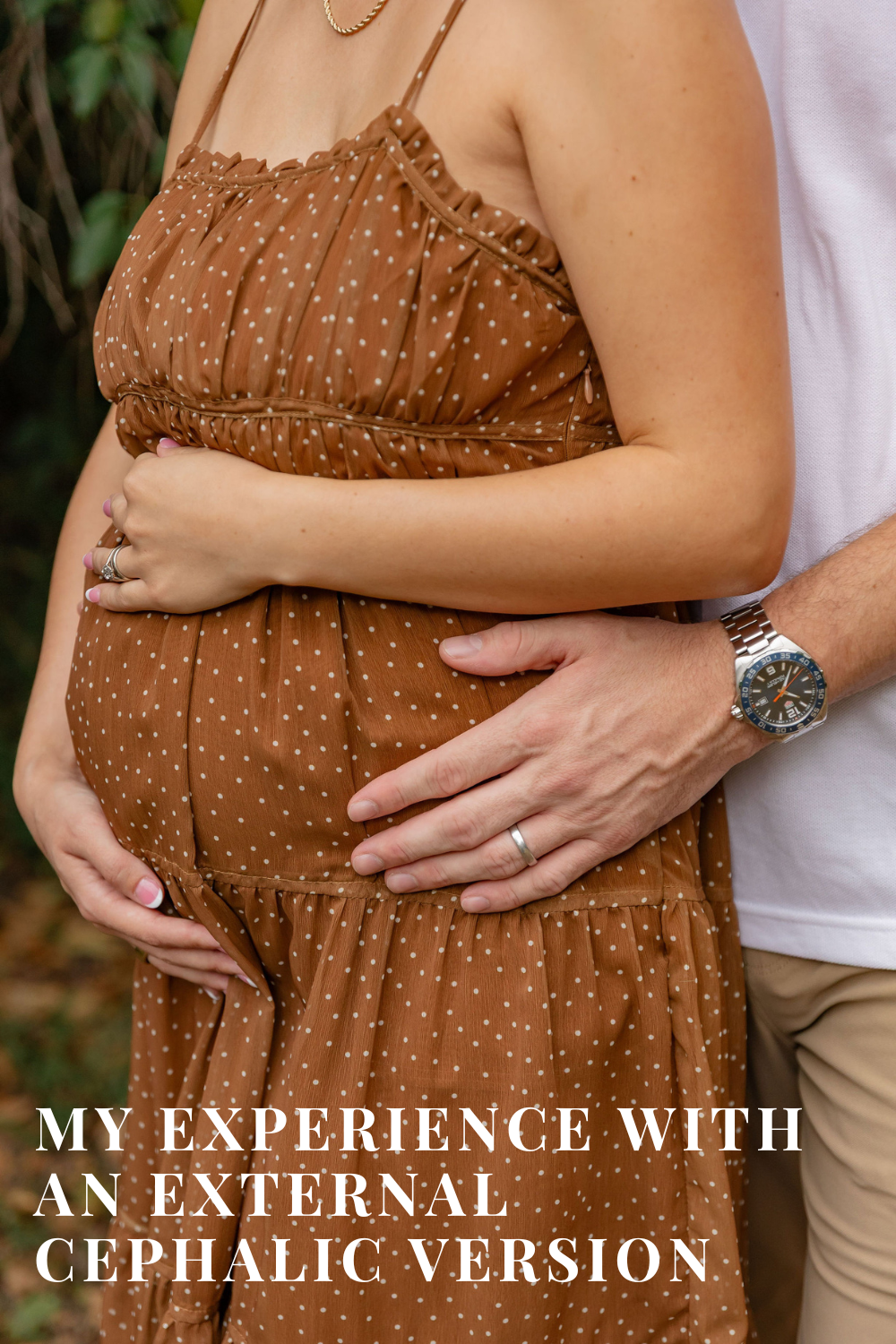
At 36 weeks, we discovered with a sonogram that our baby was breech. Something that has been very important to me during this pregnancy is to have a natural birth. Knowing this, my doctor recommended a procedure called External Cephalic Version. This is where they physically turn the baby from the outside. After much deliberation, we decided to try it. This is my experience with an external cephalic version.
Before I dive into this blog post, I want to say that this is all from my own personal experience in pregnancy and our specific circumstances. This is in no way medical advice for anyone or to persuade someone to make a specific medical decision.
With that, let’s get into it!
External Cephalic Version
What is an External Cephalic Version?
An External Cephalic Version (ECV) is a procedure where a doctor or medical physician physically turns your baby. Turning them from a breech position by manipulating the mother’s abdomen. All of this is to make sure that the baby is head down for a safe delivery position. You can read all about it on the Cleveland Clinic’s website.
There are a lot of different articles and studies that show the statistics of success rates for ECV’s. From what I have determined, it can be a very case specific procedure in terms of success. Obviously, if you are in a situation having to consider this procedure, discuss it with your doctor to see if you are a good candidate or not.
My doctor informed me that it has a 50% success rate. This wasn’t the most comforting statistic, I won’t lie. There are other factors that went into my decision which I will explain below. Ultimately, we decide to try it because a natural birth was so important to me.
My Experience Getting An External Cephalic Version
Why I decided to have an External Cephalic Version
The main reason I decided to try the ECV is because a huge goal of mine was to have a natural birth. I made the decision to deliver in a hospital setting. Obviously, it is possible to birth a baby naturally when they are breech. However, hospitals have rules and protocols that they have to follow. Another issue was exactly how our baby was breech.
We discovered that our baby was in a unique position called “oblique breech”. This means that baby was head up but also at an angle and in a C-position. Basically, my baby was stuck and couldn’t fully turn on their own. This made me a good candidate for the potential to have a successful ECV. However, it also meant that if baby was stuck, it could be more difficult to get them to move based on the position of the baby and the shape and size of my uterus.
My doctor knew what I envisioned for my first birth experience. She walked me through all of my options once we discovered this. My options were as follows. Option 1, schedule the External Cephalic Version and if it is successful, have a natural birth. Option 2, schedule the ECV and if it doesn’t work then we schedule a C-section at 39 weeks. Then, option 3, do nothing and schedule a C-section at 39 weeks to safely deliver baby. Or, option 4, wait to see if the baby turns on their own. If they did then I could deliver naturally. If they didn’t then I would have a C-section.
After discussing with our doctor, a second opinion, our insurance and each other, we decided to try the ECV. Overall, we decided that we would try. If anything, we would either be successful and continue forward as planned. Or, we would schedule the C-section knowing that we tried everything we could.
My ECV Experience
We scheduled our ECV during my 37th week of pregnancy. Most providers don’t schedule it earlier than this because if anything happens that requires an emergency C-section, the baby is technically considered full-term. We had to schedule this with the hospital and get on their schedule at labor and delivery.
It was a Saturday morning and we checked in around 7:30 am. We get to our room and our Nurse, Susan, helps us get settled. I chose to have an epidural for the procedure. My doctor recommended to do it this way because it can be a rough procedure and it helps you relax more which ultimately helps the doctor have more flexibility. I also knew that if anything went wrong, this would allow me to be awake during an emergency C-section. If you choose to go without the epidural and something goes wrong, they will have to put you under general anesthesia for the emergency C-section.
I meet with my doctor at 9:00 am and she confirms that our baby is still in the oblique breech position. She warns me that it is going to be tough and wants me to be prepared that this may not work. However, she also says she is determined to do everything that she can to make this a successful ECV.
I get my epidural around 10:00 am and then I receive a medication called terbutaline to relax my uterine muscle. My doctor and her resident came in shortly after it went into effect to begin the procedure. I was awake and my husband was able to stay in the room with me. I will warn you, this can be a brutal looking procedure. They used baby oil to help them be able to move the baby and they use a sonogram to watch what they are doing the entire time.
The External Cephalic Version Procedure
The best way for me to describe an external cephalic version is to imagine a deep tissue massage on your abdomen. There is a lot of pushing, pulling and pressure. I was very grateful to have the epidural. There was a lot of pressure and it was uncomfortable at times but it wasn’t anything horribly painful.
I did get a little stressed during the procedure between the epidural shakes, physical pressure and fear that this wasn’t working. My nurse asked if I wanted to listen to music and held onto my feet to help bring a sense of calmness to the situation. This helped so much and knowing that my husband was right next to me talking to me helped me relax.
After 15 minutes and three attempts, they were finally able to get the baby to flip! We honestly couldn’t believe it! For a while, it really looked like the baby was not going to move because of the lack of space and their size.
Post ECV
After the procedure is finished, I am cleaned up and given warm towels to help stop the shaking from the epidural. My doctor confirms that everything still looked okay and that baby and I are both showing healthy vitals.
Once they confirm that everything looks good, I am monitored for the next few hours while my epidural wears off. Since I received an epidural, I had to treat it like a surgery and wasn’t able to eat 8 hours before my procedure. My husband went to go grab me food and after I ate, I took a small nap and we watched TV while we waited for the epidural to wear off.
After the procedure, I had to be able to walk to the bathroom and be able to pee on my own before I could be discharged. After about 2 and a half hours, I am able to do this and we get discharged shortly after! We didn’t have to stay overnight and we were able to have a somewhat normal day for the rest of our afternoon. I went home and we took Ellie, our golden retriever, for a walk and later went Christmas shopping.
The next day, I woke up very sore and tender. I was expecting this but it was still very uncomfortable at times. I wore very light fitting clothing and made sure that I was able to rest for the entirety of the day.
My thoughts on the External Cephalic Version
My initial thought is that I am very grateful that we did it! I questioned it for the entire week and a half leading up to the procedure. Just like every procedure, it doesn’t come without it’s risks. I was very worried that it would end up in an emergency C-section. While there are risks, they were all very minimal at around 1% chances of happening.
Once it was confirmed that the baby was flipped and that they stayed flipped at my next doctor’s appointment, I was very happy and proud of myself for trying it. If I thought that the baby would have been able to turn on their own, I might have tried to do that initially. However, my baby had been in the same position for almost two months so we knew there was a very great chance that this was not going to happen on its own.
If you are in a similar position and wondering if you should do it, I recommend discussing it with your doctor, reading stories and researching exactly what the procedure will look like for you. Talk about it with your partner. Discuss your fears and anxieties around the procedure and go from there. If you choose to have one, I hope that it goes smoothly and that you get the beautiful birth you are desiring!